2. Big Cliff Dam to Packsaddle Park
Linked via: Nhdplus discovery 90% confidence Synced 6mo ago
Gauge Conditions
Runnable: 800.0 – 3,200.0 CFS
Data from American Whitewater & USGS
Run Map
Description
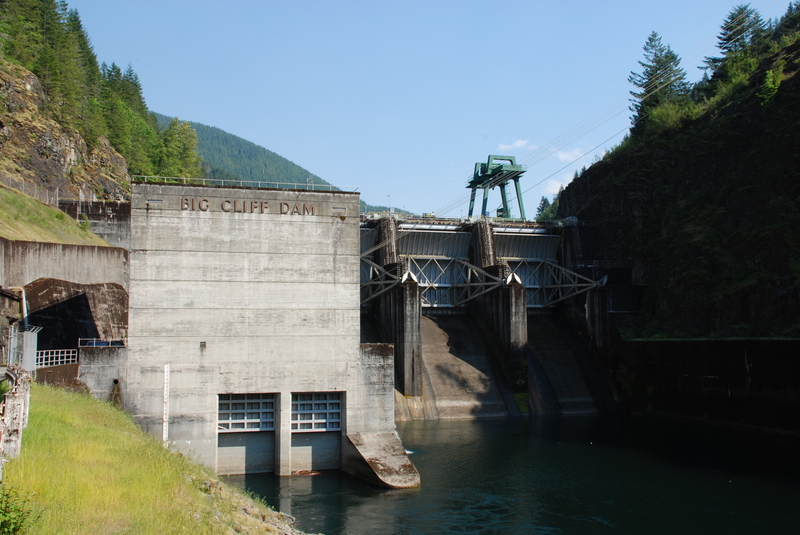
This is a beautiful section of river just downstream of Big Cliff Dam with two rapids of note. The Narrows is encountered within the first mile and can be scouted on river right. Niagara is a narrow slot further downstream that can be scouted from Niagara County Park. Just prior to the take-out the river pours over a hazardous fish collection dam that can be portaged on the right.
At the put in are some slalom gates that can be lowered if paddlers want to practice on them, please take the time to put them back up when done. Class II rapids are encountered downstream, with small features to look for if you want to spice things up. About a mile below the put in is a long class III rapid that is a noticeable step above what has come before. This rapid can be spiced up with some fun moves created by the larger boulders by those who are looking to get more of a challenge. This long rapid ends with a small river-wide hole and enters a moving pool with a generous eddy on the right for those in control.
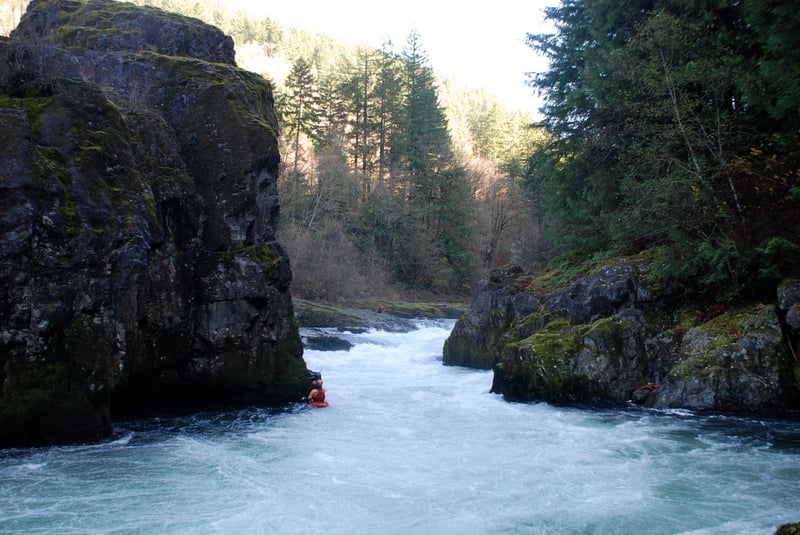
This moving pool empties into the Narrows, the largest rapid of the run during the Summer (at Winter Flows Niagara is larger). This rapid is easiest to scout and portage on the right. While the turbulent hydraulics are intimidating, this rapid has been called "the quintessential class IV rapid" and at Summer flows doesn't pose many hazards (at Winter flows the left wall at the bottom is of concern). More than one line exists so take a look and decide if the rapid is for you.
Downstream the class II continues, this is a good run for slicey river-runner boats with lots of splat rocks and fun eddy-lines.
Eventually the river builds to class III again and a large wall is visible downstream at the entrance to Niagara. The class III lead in rapid weaves between boulders and has numerous routes to choose from before the river is forced left by the wall. There is again a generous eddy on the left for paddlers in control.
The crux move in Niagara changes with flow, at flows around 1,000 cfs in the Summer it is the entrance pinch. It is a class III-IV move at most to make it through the slot, but failing to get into the narrow pinch places paddlers against a dangerous wall, so be confident you can make the easy move through the pinch, or portage high on the left from the eddy. At medium flows this move is easier, then at higher flows it gets tough again.
Below the pinch in Niagara is a pool with vertical walls, in the Summer it is a friendly pool. As flows increase much above 2,000 cfs it is no longer a safe place for class III-IV boaters and continues to have proportional push around the corner. Over 2,000 cfs this rapid should be scouted by groups unfamiliar with the run (preferably before putting on from the park). At 4,000 cfs this is a class V rapid.
Downstream of Niagara the river splits around a large rock outcrop, the right has a small boof but the left channel is going to be more fun for most with a couple breaking waves in a row. Keep an eye out in the next rapid for an excellent boof at the bottom on the center-right before things peter out.
After some easy floating, flat water and infrastructure on the right warn of the upcoming low-head dam. There is a signed portage route on the right that goes up and around the infrastructure. While local kayakers often run the far left side of the dam in the summer at around 1,000 cfs, the hydraulic in the center is extremely dangerous and has lethal potential.
After the outflow from the dam, but before entering the next riffle downstream, paddle to the right side of the river to take out at Packsaddle County Park.
A river description and photos are available from Oregon Kayaking.
Rapids in this Run (3)
Hazards & Portages (1)
Caution: The following locations may require scouting or portaging. Always check current conditions.
Difficulty
Class III-V
Length
4.0 mi
Gradient
26 ft/mi
Rapids
3
1 Hazard
Access Points
Difficulty Classes
I Easy
II Novice
III Intermediate
IV Advanced
V Expert/Extreme
VI Unrunnable
Current Conditions
5-Day Forecast
Whitewater data from
American Whitewater
American Whitewater