Nordheimer to Butler Creek Scenic
Linked via: Proximity 100% confidence Synced 6mo ago
Gauge Conditions
Runnable: 1,000.0 – 4,000.0 CFS
Data from American Whitewater & USGS
Run Map
Put-in
Take-out
Rapids/Hazards
Scenic
Recreational
Run Time Estimate
Select put-in and take-out to estimate time.
Unlock Advanced Trip Planning
See wind-adjusted speed maps, forecast planning, and detailed time estimates.
Sign in to generate an AI timing estimate for this run.
Whitewater timing varies with scouting, portages, and group pace. Use as a planning baseline.
Description
See alert above about significant changes in 2025 to Freight Train Rapid on this run!
California's Salmon River (Karuk: Masúhsav) is renowned for its whitewater, and the Nordheimer Run is its most famous stretch. This gorgeous river flows through a remote but accessible area in the central Klamath Mountains and has nearly 100 miles of runnable whitewater in its watershed. There are no dams, diversion, agriculture, or industry here, making this one of California's least developed and wildest rivers.
The Nordheimer Run begins at Nordheimer Flat (Karuk: Itróovutihirak) and continues downriver for over six miles to the Butler Creek River Access. It is commonly linked with the Butler Run to make an epic 10-mile day trip containing some of the finest whitewater anywhere.
The largest rapid on the run, Freight Train, changed in late December 2024 and is now more congested and consequential than before: carefully scout from river level! Rafts may not have a clear line through the drop at low and medium flows, making it more difficult to link the Nordheimer Run into the Butler Run. More info is below.
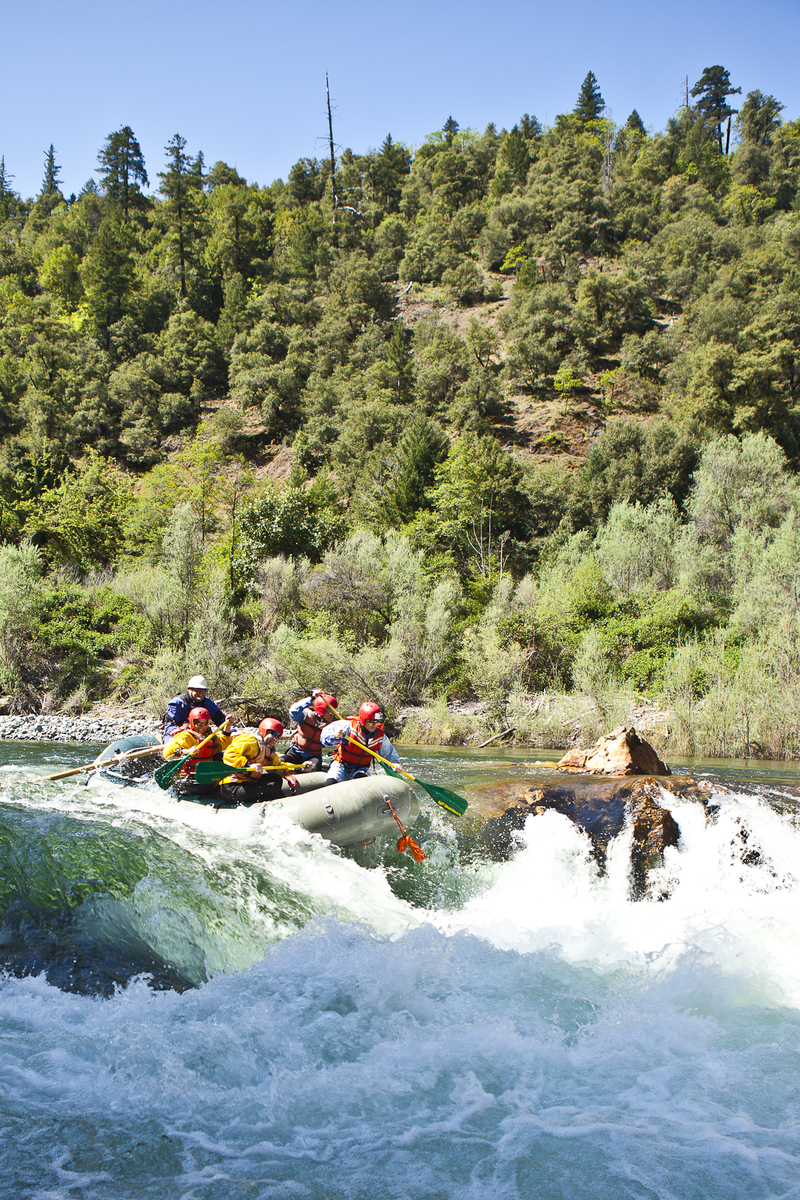
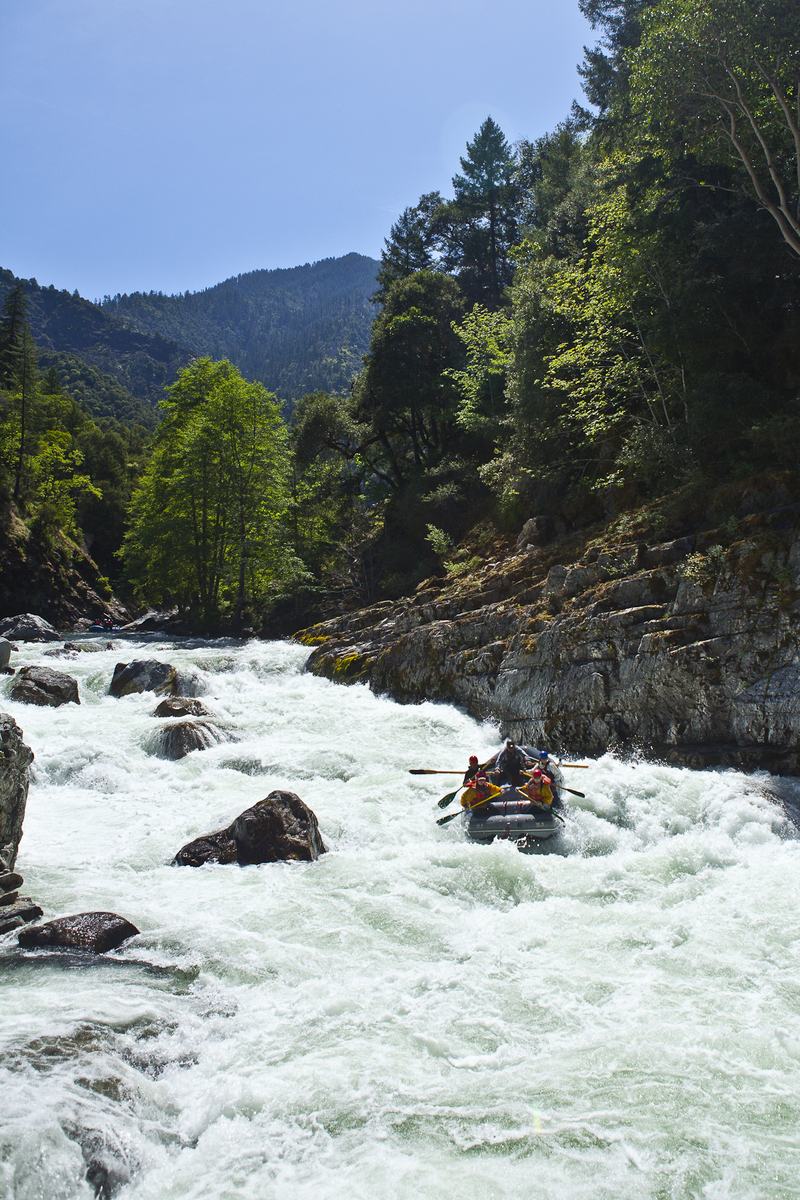
Nordheimer is a pool-drop run with plently of rapids but also some long pools. The rapids more than make up for the slow times in the pools and the run is infamous for its large, powerful rapids that include a number of Class IV drops and two Class V rapids. Rapids are formed both on bedrock and boulders. There's a little bit of granite in the river canyon on this run but most of the run is on classic Klamath Mountain metasedimentary rock, here the Eastern Hayfork unit of the Sawyers Bar terrane.
First Descent & the Era of Gonzo Rafting
Steve Sanders led a small group of kayakers on the first known descent of the Nordheimer and Butler runs on July 6, 1973, portaging six times. By the early 1980s, the river had gained a degree of popularity among boaters as word spread about its powerful rapids and stunning canyon. A frenzy of commercial whitewater rafting ensued with multiple companies running trips in the spring, often times training their guides as they paddled customers down the river. This was the era of Salmon River gonzo rafting, and although the trips were booked solid, there were few repeat customers. The river was busy during this time, and some companies even ran busses from San Francisco to the Salmon River each weekend. However, since the late 1980s, boating traffic has declined and today the Salmon River is a pretty quiet place with a handful of outfitted trips each year and a few dozen groups of boaters exploring its waters. This means you'll find an amazing river and you won't have to compete with a crowd, but you may wish there were more boaters around to help you set a shuttle.
On the River
The put-in for Nordheimer is conveniently located at the back of the US Forest Service campground of the same name, about four miles downstream of Forks of Salmon on the paved Salmon River Road near milemarker 13. The first mile below the put-in is rather flat but then the run gets going suddenly with Bloomer Falls, a short but steep and fiesty drop set in a sharp-rocked canyon that was carved out during the infamous 1964 flood and subsequently blasted in 1982 to improve fish passage.
After Bloomer, the river winds through a long set of rapids collectively known as The Maze which is also in the flood-carved canyon. By the time the river reaches Lewis Creek, about a mile below Bloomer, it leaves the scoured canyon and settles into a more typical Klamath Mountains river canyon setting, and a grand one at that.
The pace quickens again around Morehouse Creek where Tercel Turn and Airplane Turn come one after another and smaller rapids with lesser reputations, like Armadillo, continue as the river approaches the long, swooping bend of Tripp Point. At medium flows, there is a great play wave, known to locals as the Tripp Point Wave. Overall, Nordheimer is recognized more for its beauty and handful of larger IV/V rapids and abundace of III/IV rapids more than it is for play spots. You don't gain much by paddling a play boat here but you incur a penalty in the larger rapids. With the fad of running difficult rivers in rodeo boats all but over, most kayakers these days are paddling big boats or half slices on this run. The full spectrum of inflatable craft, from IKs to catarafts, R2, paddle boats, and a variety of oar rigs are used on this run; there's even been a successful descent in an inflatable sofa (a few swims, but no portages) during the annual Salmon River Whitewater Gathering held each spring.
Cascade Falls (aka Steehead Falls) is a long, complex Class V rapid downstream of Tripp Point and Portuguese Falls. Scout on river left. There are multiple lines here at any flow and, depending upon your craft and preferences, one may be better than the others. The rapid is fairly long, steep in sections, and can be quite powered up at any flow. Many a boater has grated their knuckles along the river left wall only to be insulted by a bronco ride in the hole at the bottom. Fortunuately for them, the pool below Cascade is long. Some rafters take the raft chute on far river right at medium and higher flows; this line is less fun for kayaks. Other lines navigate the ledges and boulders (some are undercut) in the middle. If the high boof is in, it's fun too (5,000 cfs or higher). Cascade can be portaged but you'll first need to boat down the middle entry to far right side to get to the portage, an unmarked scramble over bedrock. It's also possible to hike in/out to Salmon River Road on an unmaintained trail that departs from the river left bedrock area overlooking the rapid; this trail provides one of the few ingress/egress routes into the heart of the river canyon but is unmarked and can be quite hard to find on the road end (it's about halfway between the 9 and 10-mile markers).
After a long pool, Achilles (IV) follows Cascade. There is rough 4x4 road access to river level at Achilles, a place known to locals as Indian Bottom. After this, the pool-drop rhythm picks up through multiple Class III rapids including Whirling Dervish and Grants Creek as the river approaches the largest set of rapids on the run: Last Chance (IV) and Freight Train (V). Grants Creek is the last place that it is physically possible to exit the river canyon before Freight Train: this may be more important now that Freight Train has become more intense as of late 2024. The Monolith of Splat, a billboard sized slab of granite that offers up epic splats in slow current signals the gateway to Last Chance.
Last Chance (aka Big Joe) dealt enough beatings to rafters in the 1980s that it was the main filming location for The Slammin' Salmon Whitewater Bloopers, a video that still delivers on its entertainment promise, even if a bit repetitive. Lucky for today's boater, the rapid has lost much of its bite over the years and the giant hole at the bottom that beat the neon spandex off the rafters in the late 80s isn't as fearsome anymore. The rapid is still powerful and complex, so it isn't to be taken lightly since there is little separation between it and Freight Train. A swim at Last Chance risks becoming a long, threatening swim through all of Freight Train. Scout Last Chance on the right (as well as from the Salmon River Road overlook near milemarker 8 before boating).
Freight Train (aka Grants or Grants Bluff) is the largest rapid on the mainstem Salmon River, dropping about 25 vertical feet over its long and powerful run. Scout on the river right and from the road above while setting shuttle (you will not appreciate its scale nor can all of it be seen from the road).
Due to significant changes to Freight Train Rapid, most boaters will likely now choose to portage it entirely below about 3,500 cfs (see alert above). This description in italics is for Freight Train before its late December 2024 rearrangement and no longer applies in full:
*After its long entry, Freight Train is usually run down the center of the main current through increasingly large waves that make long lines of sight a challenge. Two rocks to the left of the line--known as The Horns--provide landmarks at flows below about 3,000 cfs. The first upstream horn serves to let you know you're entering the final portion of the large wave train before the crux section of the rapid. At the second horn, the rapid plunges steeply over a jumble of boulders into the diagonally left-curling Hawaii Five-O or Bomb Shelter tube wave/hole. A slight left angle and a solid right brace will help you exit the direction you want to go. The goal is to exit the curler heading slightly left to avoid the sticky Train Station Hole straight downstream (only at low to low-medium flows). The grand finale of Freight Train comes at the Angel Wings where the canyon pinches down to a 16-foot width as water piles and boils its way through--this can get very chaotic at high flows. That mutliple features within this rapid are named gives you and idea of the respect boaters give it. It's a real deal class V rapid and should be taken seriously.*
*A word of caution: at flows below 2,000 cfs, Freight Train becomes more hazardous due to the shallow rocks in the fast water at and below the Hawaii Five-O/Bomb Shelter wave/hole. A flip here at low or even low-medium flows risks a hard hit on the head, and numerous paddlers have suffered this fate, some with serious results. If flows are under about 1,200 cfs, its possible for kayakers to take a far left line after the first horn to avoid the curler, but this comes with its own challenging slot move along the river left cliff wall. Above 1,500 cfs the shallow rocks are better padded and by 2,000 cfs they are slightly underwater. It isn't until flows are about 3,000 cfs that they are more safely out of the way underwater. Freight Train can be portaged on the right via a long walk over convoulted rock but boaters will still need to run the Angel Wings at the bottom.*
Technically, the Nordheimer Run ends about a 1/2 mile below Freight Train at the Butler Creek River Access, but amazing whitewater continues four more miles through the Butler Run. In fact, the river's gradient, pace, and playfulness pick up even though overall difficulty decreases a bit compared to Nordheimer--in many ways it actually gets better. Unless you don't want any more amazing whitewater in your day, continue through the entire Butler Run (or at least the top mile down to Inga's/Duncan Creek). If you really don't want more whitewater, there's a small challenge to getting out at Butler Creek and that's the boulder bar that separates the take-out spot from the main flow of the river. You may need to get out and carry your boat over the bar then get back in to paddle the pool to the take-out when flows are below 3,000 cfs.
Flows
This run has medium flows between 1,500 and 4,500 cfs at the Somes Bar gage. It can be run lower and is still a pleasure in smaller boats down to about 1,000 cfs; inflatables and packrafts may find much lower levels acceptable though bumpy. Commercial raft companies tend to cut off trips below 1,200 cfs primarily due to the extra hazards that low flows expose at Freight Train--though with the late 2024 changes to this rapid the low-end cutoff is likely to be closer to 3,200 cfs. Above 4,500 cfs the run starts to pack a lot of punch but you won't encounter many rocks along the way. There are few breaks in the fast current at high flows. Kayaks and Creature Crafts have done the run in excess of 15,000 cfs, which is exceptionally powerful and at which a swim would be potentially disastrous.
Use one of the public phones in the cell-free watershed to call Waterline for real-time flow info: 1-800-452-1737 and enter code 0632212. Phones are at Nordheimer Campground, by the Forks of Salmon post office, at the three-mile marker on Cecilville Road, in Sawyers Bar, at Idlewild Campground, and at the Salmon River Outpost in Somes Bar, which also has a public fiber-optic WiFi hotspot.
Logistics
Please stay safe and help keep good community relations by driving very slowly on the one-lane road along this run and elsewhere in the watershed. This run is well-suited for bike shuttling.
*Put-in*
The Nordheimer River Access is behind the campground; just follow the road through the camping area continue down to a parking area near the river and the mouth of Nordheimer Creek. As of summer 2024, this road is in very good condition after the Forest Service maintained it. The campground is near the 13-mile marker on Salmon River Road, about four miles downriver from Forks of Salmon.
*Take-out*
Take out at the Butler Creek River Access alongside Salmon River Road, about 7.5 miles upriver from Highway 96 at Somes Bar between the 7 and 8-mile markers. This is a residential zone with a couple homes overlooking the river access: please be considerate and don't be surprised to get a visit from the residents. Or better yet, continue through the Butler Run to take out at the signed Brannons Bar River Access between the three and four-mile markers (some rafters continue two more miles to the Oak Bottom River Access for its shorter carry).
Camping & Amenitites
Great camping is available at Nordheimer Campground and is first-come, first-served (except for the four group sites which require a reservation). There is a small fee to camp here ($8 in 2024). There is no potable water provided but there is a bathroom, trash can, and public phone. There is a great interpretive panel with information on whitewater boating in the entire watershed, complete with a detailed map showing each run and access points with road milemarkers. The free Nordheimer River Access is at the back of the campground. As of March 2024, the Nordheimer Trail is re-opened, offering land-based biking and hiking fun at the signed trailhead located one mile up the Nordheimer Creek Road that is straight across from the campground entrance.
There is no cell service anywhere in the Salmon watershed, although there are a few scattered public phones including at the Nordheimer Campground. Help can be a long way away, so it's highly recommended to carry an inReach or other satellite communicator when on the river here. The local search and rescue crew will respond to emergencies but does not have swiftwater training or equipment: be prepared to be fully self-sufficient on the river, including for rescue.
The Salmon River Outpost in Somes Bar is a great rural store with food, drinks, books, ice cream, and free fiber-optic WiFi. The nearest gas station is in Orleans on Highway 96 about eight downriver from Somes Bar and is open regular business hours only (24-hour gas is in Weitchpec).
Additional Info
The best guide for this river system and surrounding area is Dan Menten's 2016 classic, *The New School Guide to Northern California Whitewater* (p. 91). The information on this site is more detailed and accurate, however.
Salmon River Restoration Council's Whitewater Recreation Page - great overview and detail on the whitewater of the Salmon River drainage
Salmon River Hazard Map - map of known hazards in the river and tributaries
A Wet State
CA Creeks
Creature Craft run at 10,000 cfs (video) | Creature Craft run at 15,000 cfs (video)
Rapids in this Run (20)
 Rapid
IV
Rapid
IV
Bloomer Falls
Rapid
III+
The Maze
Rapid
III
Lewis Creek Rapid
Rapid
III+
Skips
Rapid
III
Boulder Gardens
Rapid
IV-
Tercel Turn
Rapid
IV
Airplane Turn
Rapid
III+
Leaning Tree
Rapid
III
Armadillo
Rapid
III
Chrysler
Rapid
III
Tripp Point Wave
Rapid
III+
Portuguese Creek Rapid
Rapid
IV
Achilles Heel
Rapid
III
Indian Bottom
Rapid
III+
Whirling Dervish
Rapid
III
Grants Creek Rapid
Rapid
IV
Last Chance (aka Big Joe)
Rapid
V
Freight Train
Rapid
III
Butler Ledge
Rapid
Butler Creek River Access
Waterfalls (1)
Difficulty
Class IV-V
Length
6.6 mi
Gradient
31 ft/mi
Rapids
20
Access Points
Shuttle Info
The California Salmon is located in the beautiful and isolated coastal mountains of California. Cell Phone service is mostly non-existent and GPS can be misleading.
**From Sacramento, CA** Take I-5 North to Redding, CA, and as you approach Redding asses how adventurous you feel. If you decide that the adventure should be left for the river, or if you are towing a trailer/driving an oversized vehicle then take Exit 678 and merge onto CA-44 West. Take this to its end (about 2.3 miles) and follow the signs for CA-299 West. Wind through the mountains for about 90 miles on Highway 299, and then, in the town of Willow Creek, turn right onto Highway 96 and Follow it north for 45 miles. Turn Right off of route 96 immediately after it crosses the Salmon River onto Salmon River Road. Salmon River Road parallels the river; drive past Oak-Bottom Campground, Brannons Bar, and Butler Creek (alternate put-ins/take-outs). The road becomes a single lane and Nordheimer campground will be on the left about 13 miles from Highway 96.
_(Approximately 6.5 hours)_
Alternately, if as you approach Redding you decide that any time is a good time for an adventure then continue on I-5 north to Yreka, CA and follow the route below.
**From Yreka, CA** take the exit for CA Route 3, Fort Jones, Etna. Make two left turns to get on Route 3 and follow it south to Etna. In Etna turn right onto Sawyers Bar Rd/Main Street. Follow this road for about 44 miles to Nordheimer Campground (This is a single lane road; it takes about an hour and 45 min to reach the campground from Etna. The Pavement is good but the road has some significant drop-offs and no guard rails. Please drive carefully.)
_(Approximately 2.5 hours)_
Note: On a nice day with a good, reliable car I recommend either the Redding/Willow Creek Route or the Yreka Route. From Sacramento they take about the same amount of time.
**From the Bay Area** take I-80 East to 505 North to join the route above, or take Highway 101 through the towns of Eureka and Arcata (about 280 miles). Take the exit for Highway 299 towards Weaverville/Redding. Follow 299 East for 37 miles to the town of Willow Creek. In Willow Creek turn left onto CA Route 96 and follow it north for 45 miles. Turn Right off of route 96 immediately after it crosses the Salmon River onto Salmon River Road. Salmon River Road parallels the river; drive past Oak-Bottom Campground, Brannons Bar, and Butler Creek (alternate put-ins/take-outs). The road becomes a single lane and Nordheimer campground will be on the left about 13 miles from Highway 96.
_(Approximately 7.5 hours)_
Difficulty Classes
I Easy
II Novice
III Intermediate
IV Advanced
V Expert/Extreme
VI Unrunnable
Current Conditions
5-Day Forecast
Whitewater data from
American Whitewater
American Whitewater